Finding Epsilon Lyrae: The Double Double

Catalogue Names
Names Epsilon Lyrae, The Double Double
Type Multiple Star System
Constellation Lyra
Season Summer; June - November
Notes Multiple star with two personalities: a double at low magnification, and a pair of doubles at higher magnification.

This interesting multiple star system is easy to find.

Use the Summer Triangle to find the bright star Vega and the constellation Lyra. (Here are detailed instructions to find the Summer Triangle.)

Let’s inspect the constellation Lyra more closely.
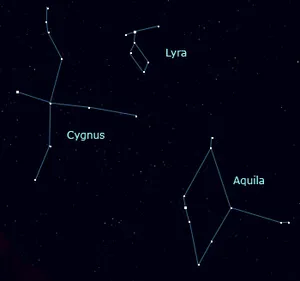
Summer Triangle
The bright star Vega sits above a 4-star diamond shape. A horizontal “hat” passes through Vega.

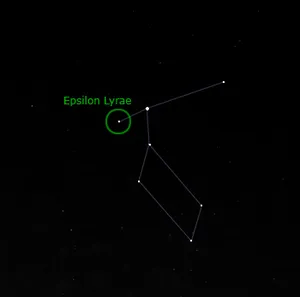
Our target, Epsilon Lyrae, is the star at the left end of the hat.
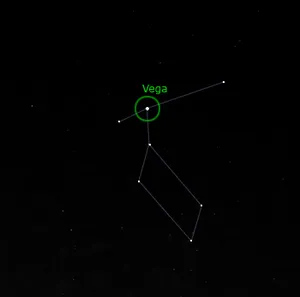
Vega n Lyra
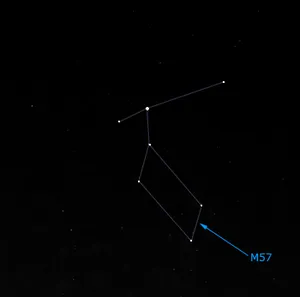
As a reminder, M57, the Ring Nebula, is on one of the lines in the diamond. That’s not our present target.
M57 in Lyra
Our target, Epsilon Lyrae, is the star at the left end of the hat.
Before you move to the eyepiece, look closely with your naked eye, and confirm that you see a single star.
Single Star
Start by observing at very low magnification – your 6x or 8x magnifying finder, or a pair of binoculars.

At low magnification, this star splits, and you will see a double star with two close-spaced components.
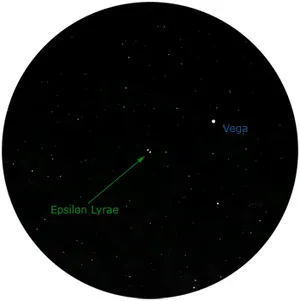
Low mag 2 stars
Next, try a series of eyepieces, gradually increasing the magnification.

Here, at 40x, we see the two components of this multiple star cleanly separated.

medium magnification
As you raise the magnification, something interesting happens. At about 100x (more or less, depending on your optics and the sky conditions), each of the two components will split into their own doubles, and you will realize that Epsilon Lyrae is actually a 4-star system. Two pairs of double stars, each orbiting its companion, also orbit each other.

Once you have this view in the eyepiece, switch between your 3 current views: naked eye (one star), magnifying finder (2 stars), and eyepiece (4 stars).
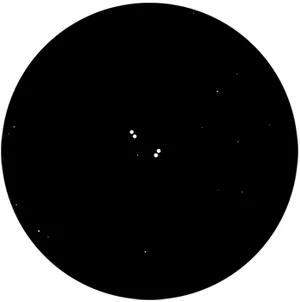
high magnification

All the above images were generated with Starry Night Pro.